
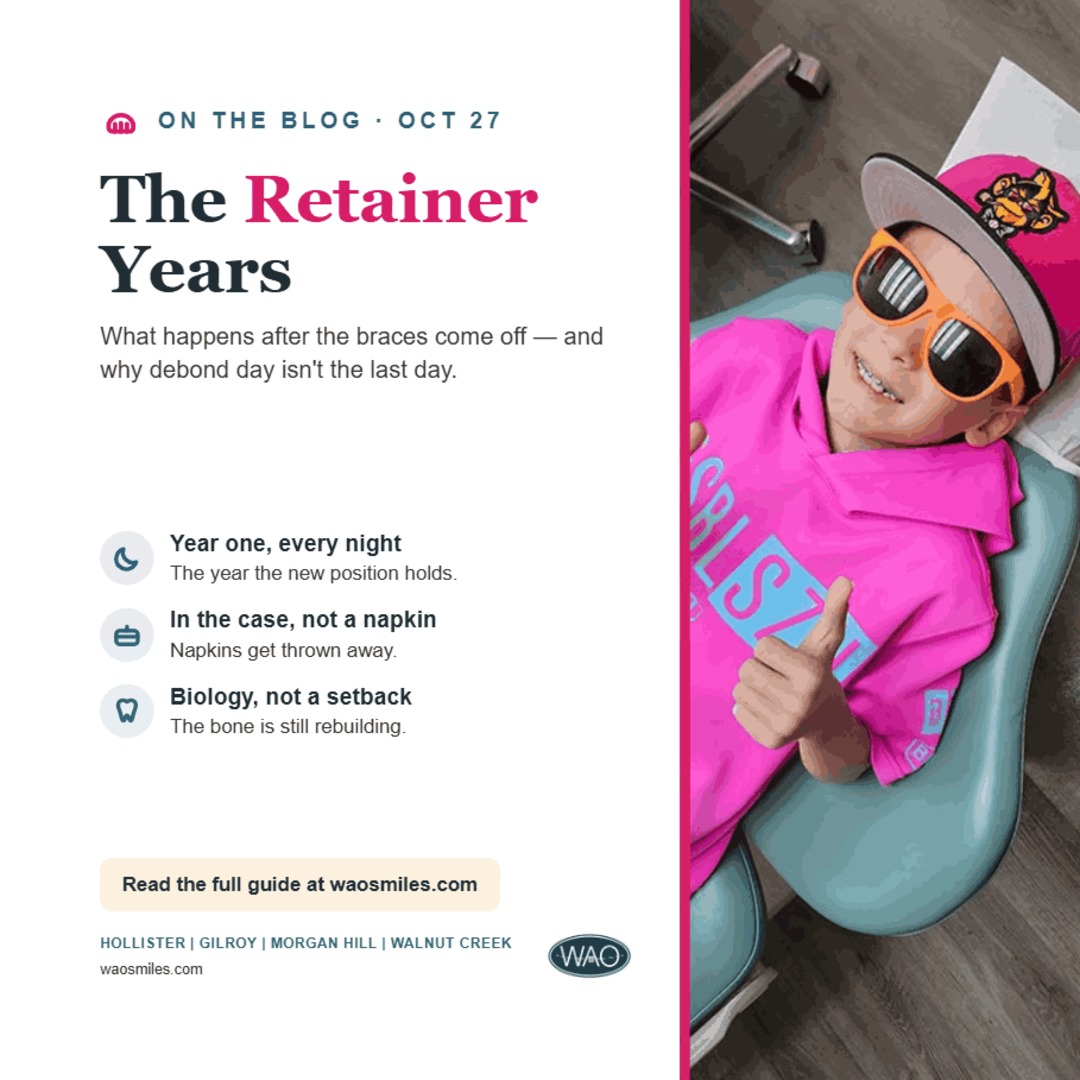
Debond day has a sound to it. The instrument clicks, the bracket lets go, and a patient who has spent two years running a tongue over metal runs it over smooth enamel instead. Then comes the mirror, and the face people make in that mirror is the reason a lot of us went into this work.
And then, almost every time, somebody asks the same question on the way out the door. So that is it, right?
Not quite. There is one more chapter, and it is the one that determines whether the first two years hold.
Teeth Are Not Set in Concrete
It helps to understand what was actually moving during treatment. A tooth is not glued into the jaw. It sits in a socket, suspended by a network of fibers called the periodontal ligament, and it is surrounded by bone that is constantly breaking down and rebuilding itself.
That is the whole trick of orthodontics. Steady, gentle pressure tells the bone on one side of a tooth to dissolve and the bone on the other side to fill in behind it. The tooth travels through the jaw, slowly, in the direction the wire is asking it to go.
On the day the braces come off, that process is not finished. The bone around each root is still soft and still reorganizing. The fibers that were stretched during treatment have not relaxed into their new length yet. The teeth are in the right position, but the architecture holding them there is still under construction.
Left alone, those stretched fibers do what stretched things do. They pull back. Orthodontists call it relapse, and it is not a sign that anything went wrong. It is simply biology finishing a sentence.
What the Retainer Is Doing
A retainer holds the teeth still long enough for the bone and ligament to catch up. That is its entire job, and it is a real one.
The first year matters most, because that is when the tissue is most willing to move. This is also, predictably, the year when the novelty has worn off and the retainer starts spending nights on a nightstand instead of in a mouth. Patients who drift during that first year are the ones who notice a lower front tooth rotating a couple of years later.
After that first stretch, most people move to wearing it at night only. And here is the part that surprises people: night wear is not a temporary phase you graduate out of. Teeth shift throughout life, with or without orthodontic history. Adults who never had braces see their lower front teeth crowd in their 30s and 40s. A retainer a few nights a week is what holds the line.
Keeping One Alive
Retainers are lost and destroyed in remarkably predictable ways, and nearly all of them are preventable.
- The napkin. A retainer wrapped in a napkin at a restaurant, a cafeteria or a family dinner ends up in the trash. Nearly every replacement we make starts with a napkin. Use the case.
- The car dashboard. Clear retainers warp in heat. A closed car on a warm day is more than enough to ruin one.
- The dog. A retainer smells like its owner, which makes it the most appealing object in the house to a bored dog. Keep the case somewhere high.
- Hot water. Rinse and brush gently with cool water and a soft brush. Boiling a retainer to clean it will reshape it.
If a retainer does go missing, call sooner rather than later. Teeth start drifting within days, and a replacement made in the first week usually still fits. A replacement ordered a month later sometimes does not, and then the conversation turns into a short round of treatment to get back to where things were.
The Long View
National Orthodontic Health Month is a good moment to say the quiet part out loud. Orthodontic treatment is not really about the months in braces. It is about what the smile looks like at 25, at 40 and at 60.
The retainer is the least glamorous part of the whole process. It is also the part that makes the rest of it permanent.